
Screenplay dialogue is usually discussed in pages: a long speech, a dense scene, a page that looks like two gray columns of talking. The underlying unit is much smaller.
A dialogue turn is one run of speech under a character cue before the screenplay moves to another element. Across 994 eligible parsed scripts, the median of the scripts' own median turn lengths is seven words. Separately, the median of each script's 90th-percentile turn length is twenty-four words.
Those are two corpus summaries, not two measurements from one imaginary “median script.” Together they show the same broad shape: screenplay conversation is built from many compact turns and a smaller tail of longer speeches.
Seven words is a reference point, not a rule
A corpus median is tempting because it looks like a prescription with empirical backing. It is not.
If a confession needs sixty words, cutting it to seven would destroy the scene. If a joke lands in two, padding it to seven would be equally absurd. The measurement tells us about the shape of screenplay dialogue in this corpus, not the correct length of an individual line.
The useful observation is contrast. Short turns establish one rhythm; a longer uninterrupted turn changes it. The rewrite question is not “is this line over seven words?” but “what happens to the scene when this character gets to hold the floor?”
A long speech changes more than word count
Long dialogue changes several things at once.
First, it changes visual density. A page with several long blocks asks a reader to stay inside one voice longer before the white-space reset of a new cue or action beat.
Second, it changes conversational control. The character holding the turn controls the verbal clock until the speech ends, somebody interrupts, or action breaks the exchange.
Third, it changes contrast. A long turn surrounded by short ones announces itself on the page before the reader has processed what it says.
That is why forty words can feel powerful in one scene and exhausting in another. The absolute length is identical; the local rhythm is not.
Turns and words answer different questions
Counting dialogue words tells you how much language a character gets. Counting dialogue turns tells you how often the conversation returns to that character.
Those can diverge sharply. One character can speak in long, infrequent blocks. Another can dominate through constant short interruptions. Their word counts may be similar while their conversational presence feels completely different.
The dialogue balance tool therefore uses attributed turn share when it summarizes speaking concentration. The question is not who wins the word-count contest; it is how repeatedly the exchange returns to each voice.
For a rewrite, the distinction is useful:
- Words describe verbal volume and density.
- Turns describe exchange frequency and how the speaking load is distributed.
- Scene mix describes how many distinct speakers participate in dialogue-bearing scenes.
None of those measurements tells you whether the dialogue is good.
Two-speaker scenes do not imply an even conversation
The corpus also gives context around scene composition. The typical per-script median is two distinct speakers in a dialogue-bearing scene. When each screenplay is weighted equally, roughly 37% of its dialogue scenes are two-speaker scenes on average, with the rest split between one-speaker and three-plus-speaker scenes.
But “two speakers” can describe radically different structures: an even back-and-forth, an interrogation, a monologue with three interruptions, or somebody repeatedly failing to get a word in.
That is why a scene audit should go one level below the cast list. Ask who owns the turns, how often control changes, and whether action punctuates the exchange.
A useful manual pass can ask:
- Who starts the exchange?
- Who gets the longest uninterrupted stretch?
- How often does the conversation return to each speaker?
- Where does action break the verbal rhythm?
- Which turn actually changes what somebody wants or knows?
The first four can be observed. The fifth still requires a writer.
When the metric earns its keep
Turn length is most useful when a reader note is vague: talky, too much exposition, the scene sits there, everyone sounds like they are giving speeches.
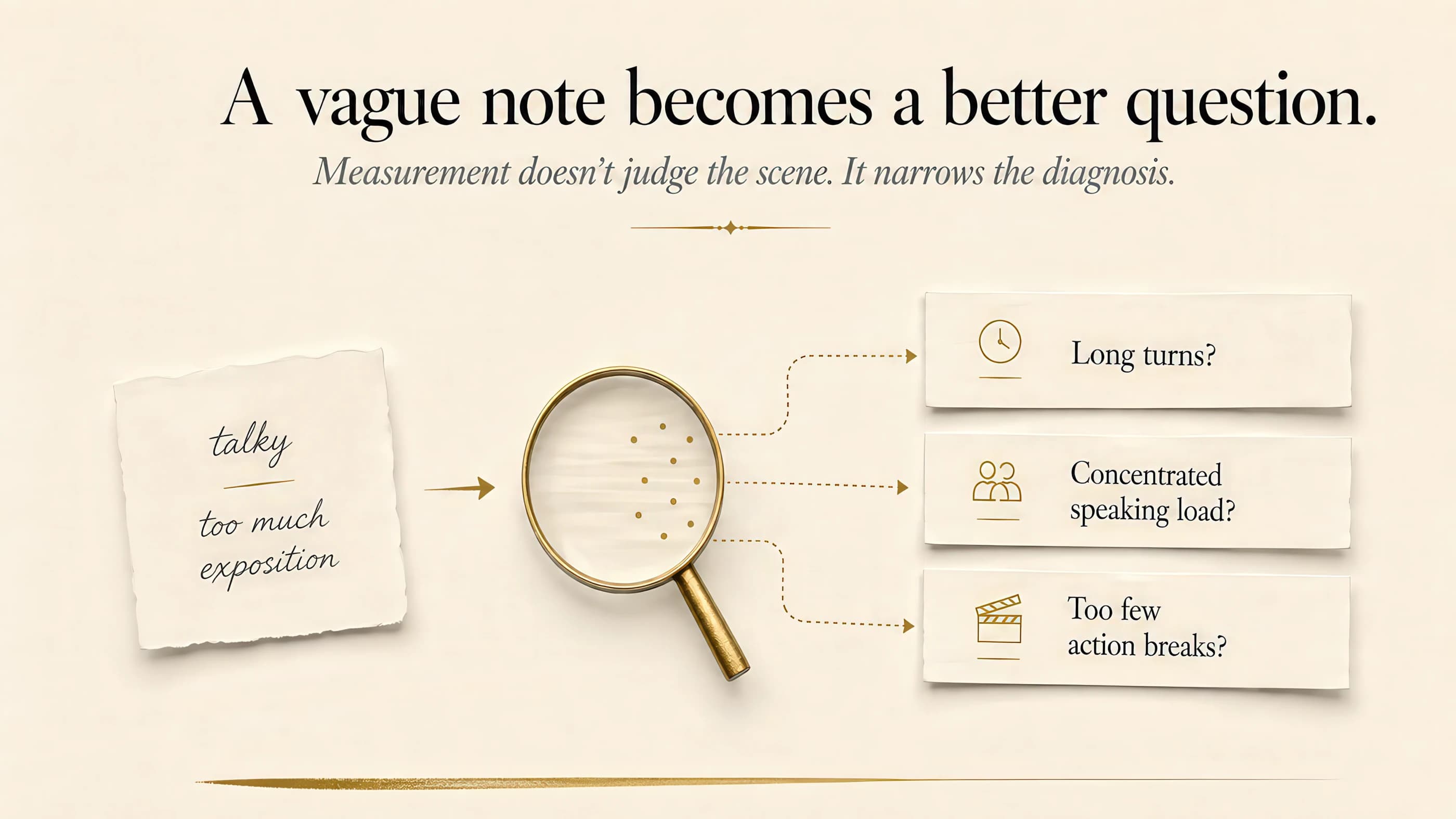
A number cannot prove any of those notes. What measurement can do is separate several possible causes. A draft may have ordinary turn lengths but unusually concentrated speaking load. It may have a conventional two-person scene mix but one character taking nearly every turn. Or the issue may have nothing to do with dialogue quantity at all.
The screenplay dialogue research desk publishes the reference distributions behind those comparisons. The dialogue balance tool maps speaking concentration and scene mix; it does not currently locate individual long-turn scenes, so line-level rhythm still belongs to a direct read of the pages.
That limitation is useful to keep clear. The point of corpus data is not to automate judgment. It is to turn “this feels different” into a more specific question, then hand the decision back to the writer.