
A screenplay with forty-seven speaking characters does not read like forty-seven equally active voices. Some names carry whole sequences. Some arrive for one exchange. Some speak once and disappear. Some matter enormously while barely talking at all.
That sounds obvious until cast size becomes a number. Then every speaker counts once, and forty-seven looks like forty-seven.
Across 994 eligible parsed scripts, the median screenplay has 47 speaking characters. But when we account for how unevenly the dialogue is distributed, the corpus median is only 6.3 effective speakers.
That is not a recommended cast size. It is a different answer to a different question: how many voices are actually carrying the conversation?
The useful distinction is population versus participation. Raw cast tells you how many named voices cross the page. Effective cast tells you how concentrated repeated participation is.
Raw cast answers the wrong question for an ensemble
“How many characters are in this screenplay?” is useful for production, table reads, casting, and the sheer number of names a reader has to remember. It is much less useful for understanding dialogue balance.
A character with one line and a character with two hundred dialogue turns both add one to the cast count. If the question is who carries the conversation?, treating them as equivalent throws away most of the information we care about.
So the dialogue research desk also measures effective speaking cast. In plain English, it asks: given how concentrated the dialogue is, how many equally active speakers would produce the same pattern?
If ten characters each carry exactly 10% of the turns, the answer is ten. If one character carries most of the dialogue and nine barely speak, the answer moves much closer to one. The useful idea is simply that frequent voices count more than one-off voices.
This does not make raw cast a bad metric. It makes it a metric with a specific job. Raw cast approximates the number of identities the screenplay asks a reader, actor pool, or production to distinguish. Effective cast approximates the diversity of the speaking load. A crowded script can be high on the first and ordinary on the second.
Bigger casts really do grow at the edges
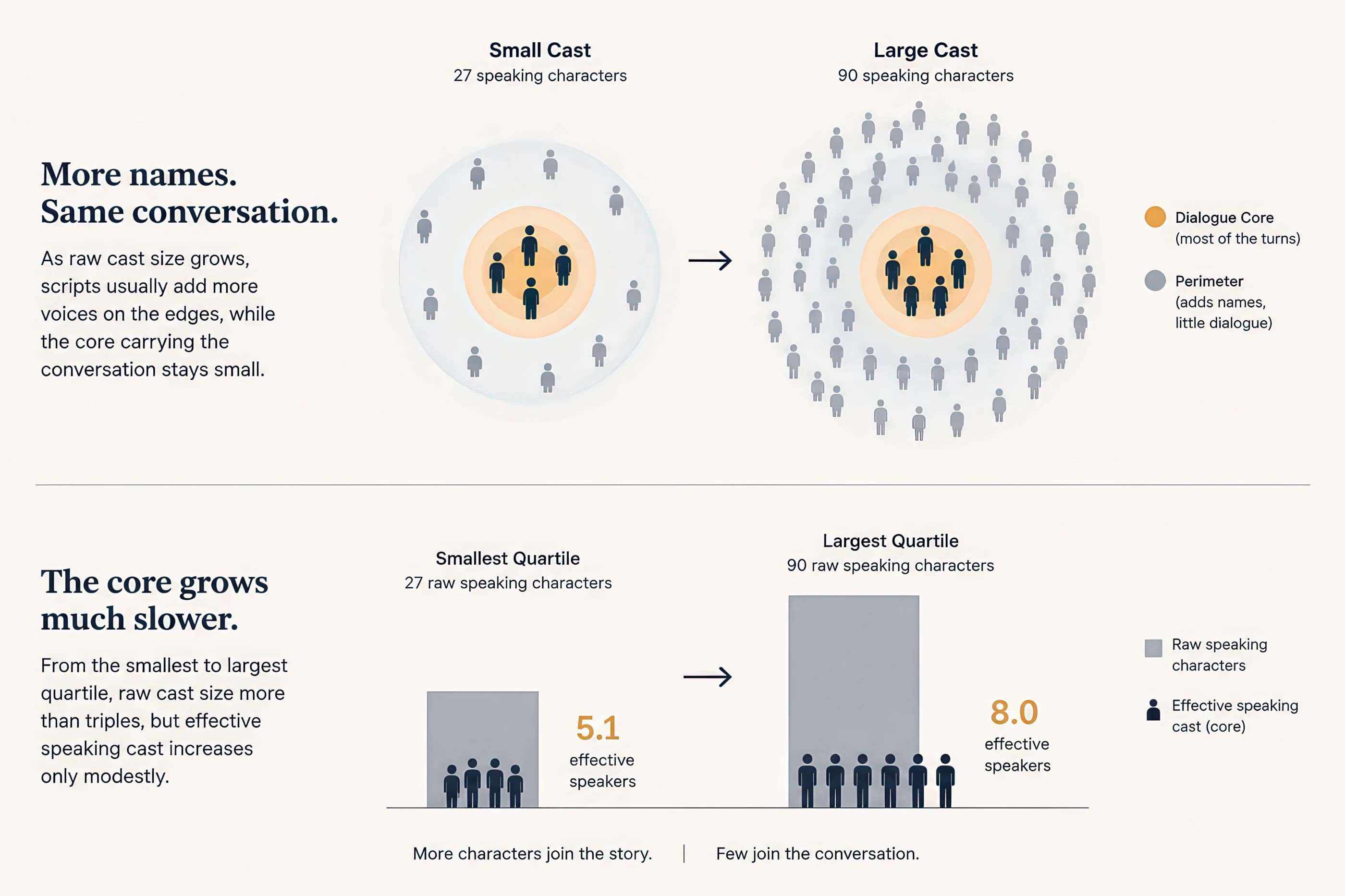
The first analysis suggested that bigger casts expand their conversational perimeter faster than their core. A second pass let us test that idea directly instead of inferring it from one concentration score.
We measured three kinds of peripheral speaker:
- a character with exactly one dialogue turn in the entire script;
- a character with five or fewer dialogue turns;
- a character who speaks in only one dialogue-bearing scene.
The pattern is much stronger than the original effective-cast comparison alone suggested.
In the smallest cast quartile, the median screenplay has 27 speaking characters. About 26% of those speakers have one dialogue turn, 53% have five or fewer, and 47% speak in only one dialogue-bearing scene.
In the largest cast quartile, the median screenplay has 90 speaking characters. Now 53% of the cast has only one dialogue turn, 79% has five or fewer, and 69% speaks in only one dialogue-bearing scene.
Put differently: the median speaker in the smallest-cast group gets five dialogue turns. In the largest-cast group, the median speaker gets one.
That is unusually direct evidence for what “the cast grows at the edges” means. Large ensembles are not simply smaller ensembles with every role scaled up. Much of the added cast is made of narrow, local voices: the witness, clerk, nurse, guard, parent, reporter, waiter, neighbor, colleague, or other role that gives a scene and a world specificity without becoming a new center of gravity.
The relationship holds across the full sample, not just the quartile endpoints. Larger casts consistently contain a higher share of one-turn, few-turn, and one-scene speakers.
Three different ways a cast can be large
That distinction gives writers a more useful taxonomy than “small cast” versus “large cast.” A screenplay can be large because it has a broad world: many local roles, but a stable recurring center. It can be large because it has a true ensemble: more recurring voices genuinely share the conversational load. Or it can be large because it has identity fragmentation: many names recur just often enough to demand memory without becoming structurally distinct.
Those three scripts can have the same raw cast count and feel completely different to read. The first may feel expansive but clear. The second may feel intentionally polyphonic. The third is the one most likely to produce the note “too many characters,” even if its count is lower than the other two.
Corpus statistics cannot classify those cases automatically, because dramatic function and reader confusion are semantic judgments. But the gap between raw and effective cast tells you which diagnosis is worth investigating.
The core grows much more slowly than the cast
The same split appears from the other direction.
The smallest-cast quartile has a median 27 raw speakers and 5.1 effective speakers. The largest has 90 raw speakers but only 8.0 effective speakers.
Raw cast size more than triples. The effective speaking core grows by only about half.
That does not mean every large screenplay secretly “has eight characters.” It means a 90-name cast and an eight-person conversational core can coexist without contradiction. They describe different layers of the same script.
Across the corpus, larger raw casts do tend to have larger effective cores, but the relationship is far from one-for-one. As the cast expands, the effective core becomes a smaller share of the people who speak at all.
This is also why effective-cast share can be more revealing than effective cast alone. Moving from five effective speakers to eight sounds like a meaningful expansion. Moving from 27 raw / 5.1 effective to 90 raw / 8.0 effective reveals that most of the expansion happened outside that core.
Five speakers carry most of the dialogue in a typical distribution
Across the corpus, the most frequent speaker carries a median 31% of dialogue turns. The top three carry 59%. The top five carry 72%.
Again, these are descriptions, not targets. A chamber piece can concentrate harder. A true ensemble can spread the load. A character with very little dialogue can still be the person everyone else is fighting over, protecting, mourning, looking for, or afraid of.
But the concentration is useful when a rewrite feels crowded. “Too many characters” is a vague note. A speaking-load map gives you better questions:
- Which characters repeatedly carry scenes, and which mostly enter at the perimeter?
- Are several one-scene or one-line roles doing genuinely different jobs for the story?
- Does a name need to be memorable, or is the screenplay asking the reader to store a label that never pays off?
- Would consolidating two narrow functions make the story clearer, or would it make the world feel implausibly small?
- Is the ensemble intentionally broad while the emotional conversation stays concentrated?
The measurement cannot answer the last four. It can tell you exactly where to look.
Reader memory and dialogue load are separate budgets
There is another reason the distinction matters. A character can consume reader memory without consuming much dialogue. A named detective who appears on pages 12, 48, and 91 may contribute very little to speaking concentration while still requiring the reader to recognize the name three times. Conversely, two central characters can dominate dialogue while being effortless to track.
That means a low effective cast does not guarantee a legible cast. It only says the dialogue itself is concentrated. When a script still feels crowded, the next audit is recurrence: how many peripheral names return after long gaps, how similar their functions are, and whether the screenplay gives the reader enough retrieval cues when they come back.
This is an important limit of the statistic rather than a flaw to hide. Conversation load and memory load overlap, but they are not the same variable.
Dialogue balance is not character importance
Speaking frequency and dramatic importance are not the same thing. A silent witness can drive the plot. A spouse can change the ending in one scene. An antagonist can dominate a film while speaking less than the protagonist. A comic side character can rack up dialogue without carrying the emotional center.
That is why effective cast is best read as a map of speaking load, not a protagonist detector or a character score.
The dialogue balance tool applies that same lens to a Fountain or Final Draft screenplay. It shows raw speaking cast, effective speaking cast, the concentration of attributed turns among the most frequent speakers, and the mix of one-, two-, and multi-speaker scenes. It does not tell you which character to cut.
The better rewrite question
There is no corpus-derived ideal number of characters. The source is a broad sample of available scripts, and it cannot tell a new story how many people it needs.
A more useful question is: does each name earn the amount of reader attention the script asks for?
A 90-person speaking cast can be perfectly legible if most of those names are local to a scene and the recurring core stays clear. A 20-person cast can feel confusing if fifteen names arrive quickly, recur just often enough to demand memory, and never become distinct.
That is the practical value of separating cast size from conversation size. One tells you how populated the screenplay is. The other tells you how concentrated its speaking load is. The gap between them is not a defect to optimize away; it is a structural choice you can finally see.
The full screenplay dialogue research desk publishes the distributions and source notes behind these figures, and the dialogue balance tool lets you inspect the same questions in a draft.